On the morning of the Fourth, kids on Stonebriar Drive tape red, white, and blue streamers to their bike spokes, clip playing cards to the frames for that engine-rattle sound, and ride together to Stonebriar Park, where someone has already started flipping pancakes. Nobody filed a permit request. No board approved a line item for bounce houses. The neighborhood does not have a homeowners association to ask in the first place.
That absence is the whole story here. Several of the gated communities elsewhere in El Dorado Hills run their calendars through an HOA: dues fund the clubhouse rental, a board signs off on the vendor, a management company sends the reminder email. Stonebriar, tucked off the intersection of White Rock Road and Latrobe Road, skipped that layer of governance when its builder, William Lyon, laid it out around a central park. The neighborhood has spent every year since proving it does not need the layer back.
The Bill Nobody Sends
Ask a Stonebriar homeowner what they pay in HOA dues and the honest answer is nothing, because there is no HOA. What residents carry instead is a Mello-Roos bond running roughly $1,200 a year and a separate annual road maintenance fee of about $200. That second charge exists because Stonebriar Drive is not a fully standard public street. Many homes here sit on private lanes tucked behind the houses, and someone has to pay for the asphalt on those lanes since no HOA reserve fund is doing it for you.
That is a smaller total bill than what a gated community layers on top of its own Mello-Roos, and it comes with a tradeoff most buyers do not think to ask about until they already live somewhere: no HOA also means no shared fund for landscaping crews, no reserve account for a future clubhouse re-roof, no professional event planner. Whatever gets organized in Stonebriar gets organized because a neighbor decided to organize it, not because a monthly check paid for it in advance.
Behind the House, Not in Front of It
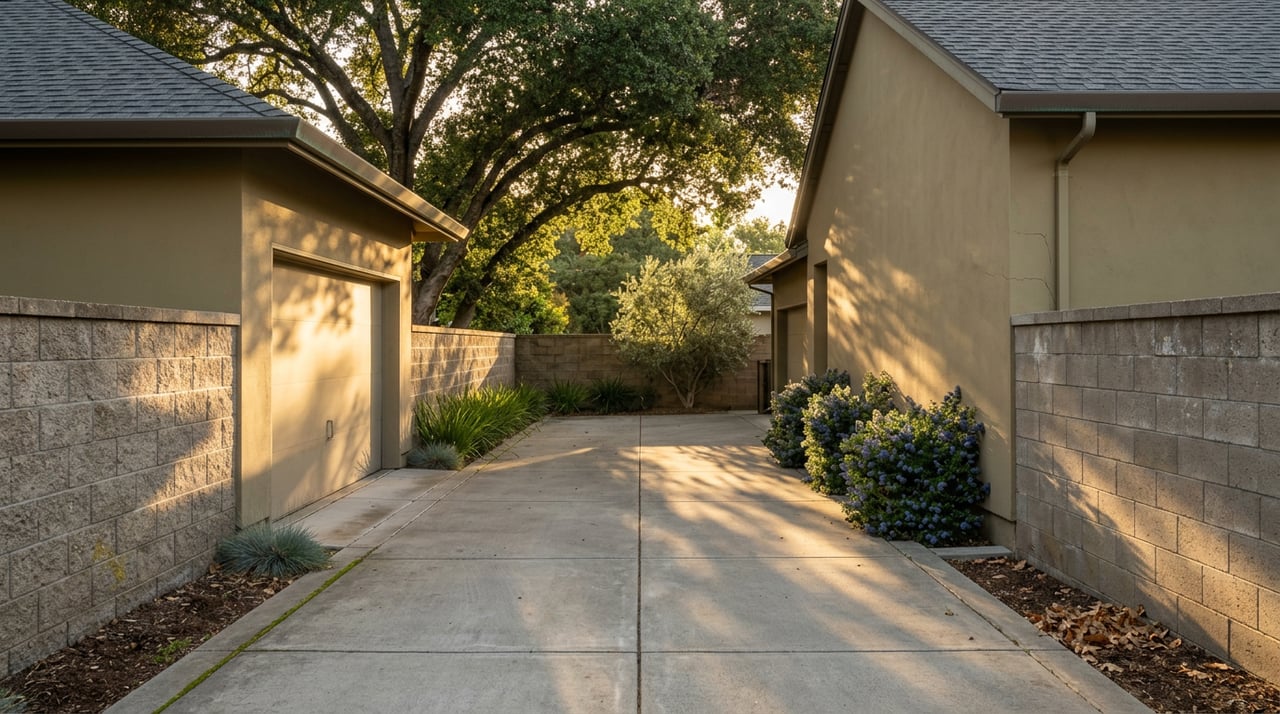
The design detail that makes the street actually livable is easy to miss on a drive-through. Most homes along Stonebriar Drive keep their garages off a private road behind the house rather than facing the street directly. Walk the block and you notice what is not there: no procession of garage doors lining the curb, no wall of parked cars angled into driveways, no trash cans staged in front of the living room window on collection day.
What is there instead is a street that reads more like a cul-de-sac than a thoroughfare, even on blocks that are not cul-de-sacs. Kids ride in the street because the street is not doing double duty as everyone's driveway. That is not an accident of good luck. It is a layout decision William Lyon made decades ago, and it is one reason the neighborhood's own Fourth of July parade route works on foot and by bike without anyone needing to close a road.
You can see the full rundown of the neighborhood's build-out and fee structure on the team's Stonebriar community guide.
The Parade Runs on Volunteers, Not Dues
Put those two facts together, no HOA and rear-facing garages, and the annual parade to Stonebriar Park stops looking like a cute tradition and starts looking like the predictable output of how the neighborhood is built. There is a park at the center because the builder put one there. There is a street safe enough for a parade because the garages are somewhere else. And there is a pancake breakfast and a run of bounce houses at the end of the route because a group of neighbors keeps deciding, year after year, to make it happen without a dues line to draw from.
Compare that to how most planned communities in this part of El Dorado County staff their events. An HOA-run neighborhood budgets for its Fourth of July gathering the way it budgets for pool maintenance, as a recurring cost approved months in advance. Stonebriar's version survives entirely on the kind of informal coordination that either exists in a neighborhood or does not. The fact that it has kept happening says something about who lives there that a fee schedule cannot.
Everyone Else Is Watching Fireworks From the Lake
The morning parade is also a study in contrast, because most of El Dorado Hills treated the Fourth differently this year. The night before, on July 3, the county's biggest Independence Day gathering happened at El Dorado Hills Town Center, where the 15th annual Fireworks and Freedom celebration ran from 6 to 11 p.m. with Funk Shui Band playing the Theatre Plaza and Hip Service taking the amphitheater stage before fireworks lit up three points around the lake and the roof of the Regal Theatre. Event organizers have said past attendance reaches around 31,000 people, with El Dorado Hills Fire, the California Highway Patrol, and the El Dorado County Sheriff's Office on site to manage the crowd.
That is the version of the holiday most of the region shows up for, a regional-scale production built for tens of thousands of attendees. Stonebriar residents could go the night before and stand in that crowd if they wanted the big show. Then the next morning, without driving anywhere or parking anywhere, they got a version of the same holiday scaled down to a few blocks and a park they already own a share of. 2026 also happens to mark 250 years since the Declaration of Independence was signed, which gave even the small pancake-breakfast version of the day a little more weight than usual.
What the Rest of the Year Looks Like
The parade is one morning a year, but the pattern behind it shows up the other 364 days too. Neighbors posting in Stonebriar's Nextdoor group consistently list dogs, home improvement and DIY, gardening and landscaping, walking, hiking and trail use, biking, live music, cooking, and photography among their top interests. Ask the same group what they love about living there and the words that come back most often are beautiful, community, dog friendly, family friendly, friendly, peaceful, quiet, safe, and walkable.
None of that is a coincidence given everything above it. A street without a row of garage doors reads as quieter and safer to walk. A neighborhood built around a central park gives dog walkers and gardeners a natural place to run into each other. And a place where residents already organize their own Fourth of July without being asked to is a place where "community" shows up unprompted when someone lists the reasons they like their zip code. The design did some of the work before any neighbor ever had to.
None of this requires an HOA to keep functioning. If anything, it is a case for the opposite: that the physical bones of a neighborhood, where the park sits, where the garages face, how the roads connect, can carry more of the social weight than most people assume a board and a fee schedule are needed for.
If you already call Stonebriar home and you are curious what that no-HOA layout and low-fee structure actually mean for your property today, the team at Turner DeMarco + Friedman knows this pocket of El Dorado Hills block by block. Reach out anytime for a free home valuation, no parade required.